At a Glance
From excessive data cleaning and rising compute costs to stale data, weak lineage, and stalled pilots, these five signs show when your data foundation is holding enterprise AI back today.
There is a specific kind of strategic misjudgment that enterprise AI programs make at scale.
Moreover, this risk can affect AI Foundation deployments at scale.
It begins with a measurement problem. Moreover, organizations investing in AI Foundation are tracking the wrong leading indicators. Additionally, these metrics are real and visible. Furthermore, they appear in board presentations and investor communications. Consequently, they create the impression of momentum.
AI Foundation reveals what they do not measure: the structural readiness of the data foundation beneath it. However, that factor predicts whether the investment will compound into enterprise-scale returns or stall in pilots that never reach production.
Only 7% of enterprises say their data is completely ready for AI Foundation adoption.
Additionally, more than a quarter report their data is not very ready or not at all, despite accelerating AI investment.
The five warning signs in this article are not theoretical. Indeed, they are operational patterns that surface predictably in enterprise environments. They are patterns where data architecture has not been modernized to support AI at scale.
They are observable in how your teams are currently working with the data infrastructure. Moreover, they also reveal how the infrastructure beneath your AI program is used.
This pattern aligns with AI Foundation principles for scalable AI deployment.
If three or more of the following five patterns describe your current environment, your AI initiative has a data architecture problem. That problem will not be resolved by a better model, a larger compute budget, or a more capable vector database. It will be resolved by the architectural interventions at the end of this article.
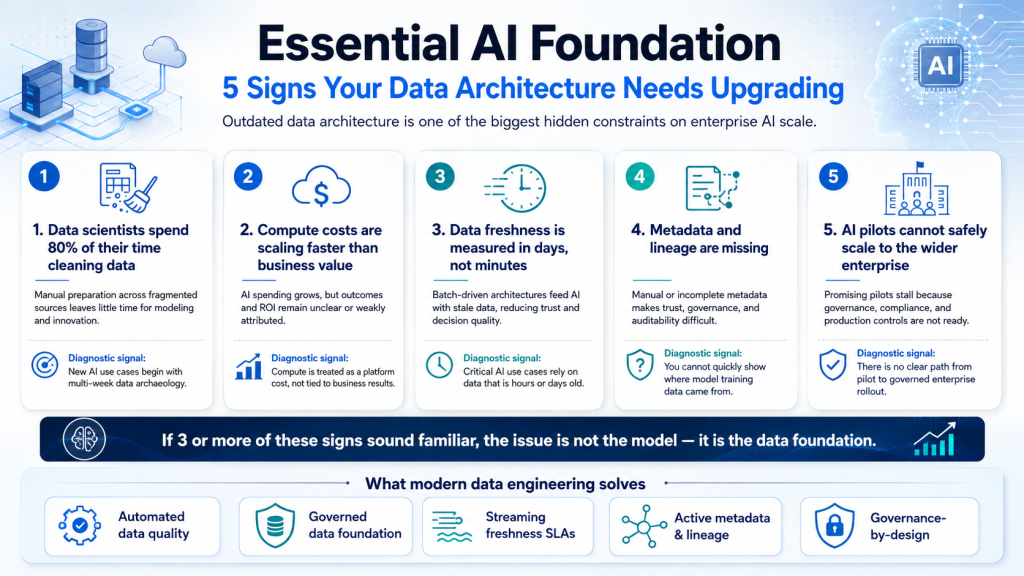
Sign 1: Your Data Scientists Are Spending 80% of Their Time Cleaning Data Instead of Training Models
This is the most visible and most consistently underestimated warning sign in enterprise data environments.
The 80/20 split has become an accepted operational reality in data science: 80% of the time goes to data preparation — finding, cleaning, reconciling, and normalizing data across fragmented sources — while only 20% remains for the actual analysis and modeling that justified hiring a data scientist in the first place. Industry surveys consistently show that between 60% and 80% of a data scientist’s time is spent on data preparation, not modeling.
The organizational cost of this pattern is material and measurable. Data scientists are among the most expensive engineering roles in any enterprise technology team. Every hour a data scientist spends fixing formatting errors, merging inconsistent datasets, and chasing down undocumented schema changes is an hour not spent building predictive models, discovering insights, or developing solutions that could generate revenue or reduce costs. This opportunity cost multiplies across entire teams and compounds over time.
The root cause is consistent across organizations where this pattern appears: the data estate was not built to serve AI. It was built to serve reporting. Schemas were designed for a specific set of known queries. Historical data was ingested without quality validation because the consumers were human analysts who navigated inconsistencies through institutional knowledge. No pipeline automation existed because scheduled batch jobs met the requirements of a world where data latency was measured in hours, not seconds.
When AI programs are deployed on top of this estate, the data preparation burden that was previously invisible — absorbed by analysts, scripted around by data engineers, tolerated as a known inefficiency — surfaces as a systematic constraint on AI productivity. The data scientists you hired to build models spend their time doing the infrastructure remediation work that should have been automated years ago.
The diagnostic question: Can your data scientists access clean, governed, production-quality data for a new AI use case within a week of identifying the requirement — or does every new use case begin with a multi-week data archaeology project?
If the answer is the latter, the architecture is working against you.
Sign 2: Compute Costs Are Scaling Faster Than Business Value
The second warning sign is financial, and it has become one of the defining enterprise technology conversations of 2026.
97% of large enterprises have committed budgets to AI, yet only roughly 5% are generating significant value at scale. The remaining 95% are trapped in a cycle of isolated use cases that simply do not scale. Fewer than one-third of decision-makers can tie the value of AI to their organization’s financial growth — and only 51% of organizations can confidently evaluate AI ROI at all, despite average monthly AI budgets rising by 36% in 2025.
The consequence is visible in finance departments across Fortune 500 organizations in 2026. Enterprises that deployed generative AI across customer service, internal workflows, and product features discovered that the cost of running AI in production, at the volume production actually demands, bore no resemblance to the cost of running AI in a pilot. Some organizations reported monthly AI compute bills in the tens of millions of dollars. Others found that the token consumption of a single agent workflow, running continuously across concurrent enterprise processes, was generating costs that scaled faster than the revenue or productivity gains it produced. Forrester’s 2026 Technology and Security Predictions found that fewer than one-third of decision-makers can tie AI value to financial growth, and that enterprises will defer 25% of planned AI spend into 2027 as ROI scrutiny intensifies.
The mechanism connecting data architecture to compute cost inflation is specific: when AI systems operate on low-quality, incomplete, or stale data, they require more inference cycles to produce usable outputs. Retrieval-augmented generation systems that cannot reliably locate relevant context retrieve more documents and process more tokens to compensate for poor discoverability. Agents that encounter inconsistent data make more tool calls attempting to resolve contradictions. Models grounded in stale data produce outputs that require human review and reprocessing — adding labor cost on top of compute cost.
A single agent-driven workflow can cost five to ten times as much as a standard prompt-response interaction. When those workflows are operating on a fragmented data foundation, the cost multiplier applies to every query — and the business value the query was designed to produce is systematically degraded by the data quality problems the compute budget is compensating for.
The diagnostic question: Can your organization trace AI compute spend to specific business outcomes — or is AI cost treated as a platform expense whose ROI is measured by capability rather than value delivered?
If AI is a cost center without a clear outcome attribution model, the architecture is generating spend without generating confidence.
Sign 3: Data Freshness SLAs Are Measured in Days or Weeks, Not Minutes or Hours
The third warning sign is the one most directly connected to the gap between what enterprise data estates were designed for and what AI requires of them.
Batch ETL tools and scheduled pipelines were built for an earlier generation of data needs — one where delays of several hours or even a full day were acceptable because the consumer was a human analyst reviewing a report the following morning. The data freshness profile of most enterprise environments still reflects this design heritage. Most enterprise environments operate with customer data that is 30 minutes to 24 hours old by the time any downstream system can access it — and for domains fed by weekly or monthly batch processes, the age of data at point of consumption can be measured in days.
This latency profile is structurally incompatible with the operational requirements of AI in 2026. An AI system making a real-time personalization decision is operating on a customer profile that was last updated yesterday. A fraud detection agent is evaluating a transaction against a risk model fed by data from a nightly batch run. A supply chain optimization agent is routing decisions through inventory data that reflects warehouse state from twelve hours ago. In each case, the agent’s output is bounded by the age of the data it is reasoning over — and the batch architecture beneath it is systematically ensuring that age is measured in hours or days, regardless of how capable the model itself is.
Data that is even slightly outdated can lead to incorrect insights, poor model performance, and missed opportunities — especially in fast-moving domains like finance, operations, and customer experience where conditions change frequently. The specific business impact depends on the domain, but the mechanism is consistent: AI systems that operate on stale data produce outputs that are accurate relative to a historical state of the world rather than its current state, and the gap between those two things is where business value leaks out of AI programs silently.
SaaS companies report 20–30% higher dashboard usage when data is under 10 minutes fresh versus 24-hour batch data — a consumer signal that directly indexes user trust in the currency of the data they are seeing. When AI systems serve as the interface between enterprise data and business decisions, the freshness of the underlying data determines the trustworthiness of the output. A data freshness profile measured in days is a trust deficit that no model improvement can close.
The diagnostic question: What is the documented age of data at point of consumption for your three most critical AI use cases — and is that age formally monitored and SLA-governed, or is it assumed to be acceptable because it was never precisely measured?
If the answer is that data freshness is not formally measured or governed, you are operating AI systems whose reliability is unknown.
Sign 4: Metadata and Lineage Are Manual, Undocumented, or Missing
The fourth warning sign is the one with the longest tail of consequences — because unlike the previous three, which affect AI performance visibly and immediately, metadata poverty degrades AI trustworthiness in ways that often remain invisible until they surface as a governance failure or a production incident.
Only 11% of organizations have high metadata management maturity, according to DATAVERSITY’s 2025 Trends in Data Management survey. In the 89% of organizations with low or medium maturity, the metadata situation follows a predictable pattern: data lineage documentation exists for the systems that were in place when the first governance initiative ran, but not for the pipelines added since. Business glossaries were created by a team that was reorganized. Data ownership is asserted in a RACI document that no current engineer references. Manual lineage contains up to 35% undocumented transformations — meaning more than one in three data transformations in a typical enterprise data pipeline has no governance record of what it does, where it came from, or who is responsible for it.
The AI-specific consequences of this pattern are severe and compounding. Without metadata, AI systems cannot reliably evaluate the trustworthiness of the data assets they retrieve — they have no mechanism to determine whether a dataset is current, owned, validated, or relevant to the query at hand. Without active metadata management, a schema change sits undocumented until someone notices a broken report, an AI agent returns a confidently wrong answer, or a governance audit reveals a gap. In a production AI environment, where agents are making decisions continuously without human review at every step, the gap between a schema change and its detection can represent thousands of automated decisions made on incorrect data.
The regulatory dimension compounds the organizational risk. The EU AI Act, with substantive obligations phasing in from early 2025, creates legal requirements around training data provenance and documentation that manual metadata processes cannot reliably satisfy. An organization whose lineage documentation is partial, manually maintained, and not continuously updated is not only exposing itself to AI quality failures — it is creating compliance exposure in an environment where regulators are increasingly requiring organizations to demonstrate the provenance of data used in consequential AI decisions.
The diagnostic question: If a regulator, board member, or enterprise customer asked you to produce a complete, auditable record of the data used to train your most consequential AI model — the specific sources, versions, transformations, and quality validations applied — could you produce that record within 24 hours without manual reconstruction?
If the answer is no, your metadata and lineage posture is a production risk.
Sign 5: Early AI Initiatives Cannot Be Safely Rolled Out to the Wider Enterprise
The fifth warning sign is the one that is most strategically visible — and most frequently misdiagnosed as a model, adoption, or change management problem when its actual root cause is data architecture.
Only 10% of AI agent initiatives successfully scale to production, according to Composio’s 2025 AI Agent Report — despite 67% of organizations reporting measurable gains from agent pilots. The delta between pilot performance and production scaling is not model capability. It is the integration layer that bridges the pilot sandbox to operational reality. More starkly, 88% of AI agent pilots never reach production. Of the deployments that do go live, 22% report negative ROI at 12 months.
The governance gap that prevents safe enterprise rollout is specific and structural. In a pilot environment, governance is effectively free: a small team, a controlled dataset, a sandboxed environment, and no live customer data. The AI system’s outputs are reviewed by the team that built it, using their institutional knowledge to catch anomalies. Security, compliance, and legal have not been engaged. The data being used is well-understood because it was selected specifically for the pilot. None of these conditions survive the transition to production.
The moment a deployment touches live customer data or internal financial records, an entire apparatus of oversight must be mobilized: data loss prevention policies, copyright risk assessments, compliance audits for decision-making bias, and security reviews for data flows that the pilot never exposed. These are ongoing, compounding costs that grow in tandem with the deployment. In an environment where the data architecture is fragmented, ungoverned, and lacks lineage, these oversight requirements cannot be satisfied — not because the organization lacks the governance will, but because the data infrastructure provides no auditable foundation to govern against.
Agentic AI pilots are being evaluated in sandboxed environments disconnected from production data infrastructure. They are being built without the governance infrastructure required for board-level production approval. The result is a portfolio of impressive pilots that the organization cannot approve for enterprise deployment — not because the AI does not work, but because no one can demonstrate with confidence that it will work correctly on production data, governed by production policies, at production scale.
Gartner predicts that through 2026, organizations will abandon 60% of AI projects that are unsupported by AI-ready data. The abandonment is not a model failure. It is a data foundation failure expressing itself at the governance threshold.
The diagnostic question: For your most advanced current AI initiative, does a documented path exist from its current pilot state to a production deployment that satisfies your organization’s security, compliance, data governance, and audit requirements — and is that path unblocked today?
If the answer is no, the governance infrastructure beneath the AI does not yet exist.
The Resolution: What Modern Data Engineering Solves
The five warning signs described in this article share a common root cause: data architecture designed for a reporting era being asked to serve an AI era. They share, equally, a common resolution path — a set of architectural interventions that modern data engineering disciplines have developed specifically to address them.
The resolution to Sign 1 — data scientists spending most of their time cleaning data — is automated pipeline infrastructure that applies quality validation, schema enforcement, and data normalization at the point of ingestion, before data reaches the data science team. When the pipeline does the preparation work automatically, the data scientist starts with a clean, governed, production-quality dataset rather than a raw extract that requires manual remediation. The 80% preparation burden does not disappear overnight, but it becomes an engineering priority with a concrete path to reduction rather than an invisible tax absorbed by your most expensive analytical talent.
The resolution to Sign 2 — compute costs scaling faster than business value — is a governed data foundation that reduces the inference overhead AI systems generate when compensating for poor data quality. When retrieval systems operate on well-cataloged, semantically rich data assets, they locate relevant context with fewer retrieval calls. When agents operate on consistent, current data, they resolve queries with fewer reasoning steps. When data quality is enforced at the pipeline level, the reprocessing and human review costs that inflate AI operational budgets are reduced at source. Clean data is cheaper to reason over than dirty data — at every layer of the AI stack.
The resolution to Sign 3 — data freshness measured in days — is streaming data pipeline architecture with formal, monitored freshness SLAs. Change Data Capture from operational systems, event streaming for cross-domain coherence, and continuous monitoring of data age at point of consumption replace the scheduled batch windows that introduce staleness into AI data environments. The engineering transition from batch to streaming is not trivial — but it is a one-time infrastructure investment whose return is permanent: AI systems that operate on data whose age is measured in seconds rather than hours, governed by formal commitments rather than assumed tolerances.
The resolution to Sign 4 — missing metadata and lineage — is active metadata management: an automated system that captures, maintains, and exposes metadata continuously across the entire data estate, without requiring manual curation for each new data asset. Active metadata management continuously watches how teams query tables, join columns, use documentation, and encounter quality issues — those signals power automatic classification, smarter recommendations, and stronger governance, all without manual setup for each new data asset. The compliance benefit of an automated lineage system — the ability to produce an auditable provenance record for any AI model’s training data in minutes rather than weeks — is not aspirational. It is an operational capability that automated metadata platforms deliver in production today.
The resolution to Sign 5 — AI initiatives that cannot safely scale — is governance-by-design rather than governance-by-retrofit. The organizations that successfully move AI from pilot to production are the ones that embedded access controls, audit logging, data lineage tracking, and policy enforcement into the data infrastructure before the AI was built on top of it, not after the pilot succeeded and the production approval process revealed that those controls were absent. Organizations that embed AI governance frameworks early move faster later — because the governance infrastructure that enables production approval is already in place when the AI is ready to scale.
The common thread across all five resolutions is architecture sequence: building the data foundation before deploying AI at scale, not after. The organizations that have made this sequence correctly — that modernized the data layer before committing to enterprise-scale AI deployment — are the ones generating measurable returns. The organizations that made it in the other order have large AI portfolios with small production footprints and growing compute bills they cannot justify to their boards.
Read Data Engineering Fundamentals for a Scalable AI Enterprise for the broader research context.
Frequently Asked Questions
1. How do I know if my data architecture is ready for AI?
A strong AI-ready data architecture should provide clean, governed, current, and traceable data to AI systems without extensive manual preparation. If teams spend weeks cleaning data, freshness is poor, lineage is incomplete, or pilots struggle to move into production, the underlying architecture likely needs modernization.
2. Why do data scientists spend so much time cleaning data?
In many enterprises, data estates were originally designed for reporting rather than AI. Fragmented sources, inconsistent schemas, weak validation, and limited pipeline automation force data scientists to spend significant time preparing data before they can begin modeling or analysis.
3. How does poor data architecture increase AI costs?
Poor-quality or fragmented data can force AI systems to perform more retrievals, reasoning steps, tool calls, and reprocessing to produce usable outputs. This increases compute consumption while also making it harder to connect AI spending directly to measurable business outcomes.
4. Why is data freshness important for enterprise AI?
AI systems make decisions based on the data available to them. When critical data is hours or days old, AI may generate outputs that accurately reflect a past state rather than the current business environment. Modern AI use cases therefore require monitored freshness SLAs and, where appropriate, streaming or real-time data pipelines.
5. What role do metadata and data lineage play in AI?
Metadata and lineage help organizations understand where data came from, how it was transformed, who owns it, and whether it can be trusted. Without this visibility, governing AI outputs, investigating errors, auditing model inputs, and demonstrating compliance becomes significantly more difficult.
6. Why do successful AI pilots often fail to scale into production?
Pilot environments are usually controlled, limited, and manually supervised. Enterprise deployment introduces requirements around security, compliance, governance, auditability, access controls, and live production data. If the underlying data architecture cannot support these requirements, a technically successful pilot can still fail to reach production.
7. What should enterprises modernize before scaling AI?
The priority should be the data foundation beneath AI. This can include automated data quality controls, governed pipelines, streaming and freshness monitoring, active metadata management, lineage, access controls, audit logging, and policy enforcement built directly into the architecture.
8. Can a better AI model fix problems caused by poor data architecture?
Not usually. A more capable model cannot compensate for structural problems such as stale data, inconsistent sources, missing lineage, weak governance, or unreliable pipelines. When multiple warning signs appear together, the constraint is often the data foundation rather than the model itself.