AI shopping assistants are changing how consumers discover, compare, and purchase products. For retailers, the implications extend well beyond the digital storefront.
A customer looking for a laptop might visit several websites before making a decision. They compare specifications, read reviews, check prices, look for discounts, and confirm delivery availability.
Retailers have spent years making this process easier. Search functionality, product recommendations, personalized content, and checkout optimization have all been designed around the customer navigating the shopping experience, agent commerce.
Now consider the same purchase handled through an AI assistant.
The customer specifies a budget, preferred specifications, intended usage, and delivery requirements. The assistant searches available products, compares suitable options, and presents a shortlist. Depending on the services and integrations available, it may also help manage the shopping cart and initiate checkout.
The consumer still determines what they want and whether to purchase it. Much of the work involved in finding and evaluating the product can take place elsewhere.
This creates an important question for retailers: how should a commerce platform operate when some of its interactions come from software acting on behalf of customers?
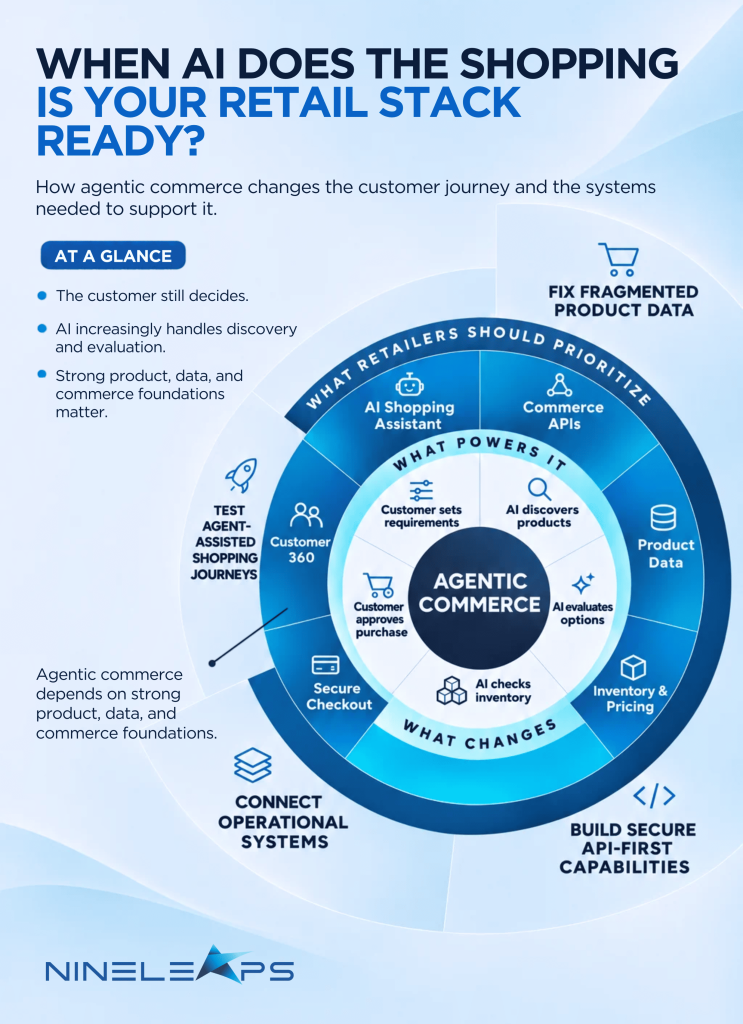
What Is Agentic Commerce?
Agentic commerce refers to shopping experiences in which AI-powered systems help consumers discover products, evaluate options, and perform purchasing-related tasks.
Unlike conventional recommendation engines that primarily suggest products within a website, agent commerce systems can potentially coordinate activities across multiple retailers, services, and transaction interfaces.
The degree of autonomy varies. Some systems assist with product research and comparison, while more advanced implementations may interact with inventory, shopping carts, checkout systems, and order-management services under customer-defined permissions.
For retailers, agent commerce introduces another type of customer interaction: software that needs to understand product information and communicate reliably with commerce infrastructure.
How AI Shopping Assistants Are Changing Product Discovery
Traditional e-commerce requires customers to work within the structure of a retailer’s website.
They navigate categories, apply filters, compare product pages, and interpret the information presented to them.
AI-assisted shopping offers a different interaction model. Customers can describe their requirements in natural language, leaving the assistant to translate those requirements into product searches and comparisons.
A request such as find a lightweight laptop under $1,200 with good battery life, suitable for programming, and available for delivery this week contains several constraints.
A shopping assistant needs to interpret those constraints, identify relevant products, assess the available information, and determine which options satisfy the request.
Some requirements are straightforward. Price and availability can usually be compared using structured data.
Others require interpretation. Battery life depends on usage conditions, while suitability for programming may depend on factors the customer has not specified.
A useful assistant must therefore balance explicit product attributes with information that may be incomplete or subjective.
For retailers, the quality of the underlying product information becomes important to how effectively these systems can evaluate their offerings.
Google Universal Cart and the Emergence of Agentic Shopping
In October 2026, Google launched Universal Cart in the United States, bringing shopping activity across Google Search and Gemini into a shared interface.
Users can save products from multiple retailers, track price changes, receive inventory notifications, and identify available promotions. Supported purchases can be completed through Google Pay or transferred to the merchant’s website.
Universal Cart is not a fully autonomous shopping agent making independent purchasing decisions. Google positions it as an experience that helps customers organize their shopping while retaining control over transactions.
Nevertheless, the development illustrates how product discovery and checkout can become less dependent on visits to individual retailer websites.
An important part of this transition is the Universal Commerce Protocol (UCP), an open standard designed to support commerce interactions between consumer interfaces, merchants, and payment providers.
UCP provides a common framework through which supported services can communicate rather than requiring every participant to establish entirely separate integrations.
The protocol also allows participating merchants to retain their business logic and remain the merchant of record.
For retailers, this creates an opportunity to reach customers through external interfaces while continuing to manage transactions and fulfillment.
Why Structured Product Data Matters for AI Shopping
Consider two retailers selling office chairs.
The first has a well-designed product page with attractive photography and a persuasive description. However, its structured product information contains only the name, price, and a few general features.
The second provides detailed specifications, including dimensions, materials, weight capacity, adjustable components, warranty coverage, and available variants.
If a customer asks an AI shopping assistant to find an ergonomic chair suitable for a particular desk height and body weight, the second retailer provides more information against which those requirements can be evaluated.
That does not guarantee a recommendation. Product rankings depend on multiple factors, including how shopping platforms interpret relevance and which information they can access.
Still, incomplete product information creates an avoidable disadvantage.
A human shopper might infer details from photographs or descriptions. Automated systems need reliable information they can retrieve and interpret.
This increases the importance of Product Information Management (PIM) systems, consistent product taxonomies, and structured attributes.
Descriptions should remain useful to human readers, but critical specifications need to be represented accurately in the underlying catalog.
Product information also needs to be consistent across channels. Conflicting specifications, incorrect variant relationships, or inconsistent identifiers can make it harder for an AI assistant to determine which product is being offered.
Preparing Retail Technology for Agentic Commerce
Making a catalog accessible to AI systems is only one part of the preparation.
Shopping involves activities that depend on operational systems working together.
Accurate Inventory and Real-Time Pricing
A product recommendation becomes less useful if the item is unavailable or its price has changed.
Retailers need reliable connections between product catalogs, inventory management, pricing engines, and promotional systems.
For businesses with frequent inventory changes, the freshness of this information matters.
An AI assistant that retrieves outdated availability may recommend a product the retailer cannot fulfill. Similarly, an incorrect promotion or delivery estimate can create expectations that the merchant’s checkout system cannot satisfy.
These problems already affect conventional e-commerce, but automated shopping interfaces may expose inconsistencies across channels more directly.
The same dependency on reliable operational data is evident in AI-driven inventory management, where demand sensing and shelf-level intelligence help retailers respond to changing availability. For agent commerce, that information also needs to reach the systems recommending products to customers.
An AI shopping assistant is only as useful as the product and availability information it can access.
Secure Commerce APIs and Checkout Integration
Traditional online stores allow customers to select variants, apply promotional codes, choose delivery options, and complete payments through web interfaces.
Agent-compatible commerce requires supported ways to perform equivalent operations programmatically.
Secure APIs and standardized protocols can allow authorized systems to retrieve availability, prepare orders, calculate charges, and interact with checkout services.
Those interfaces need appropriate validation.
An automated client should not be able to bypass product restrictions, apply ineligible discounts, or submit duplicate orders because of a failed request.
Clear transaction states, idempotency controls, authentication, and consistent business rules remain essential.
This is also where composable commerce architecture becomes relevant. Separating capabilities such as product search, checkout, promotions, and payments into well-defined, API-accessible components gives retailers greater flexibility to introduce new shopping interfaces without replacing their entire commerce platform.
A modular architecture does not automatically make a retailer ready for agent commerce. However, it provides a more adaptable foundation for integrating emerging protocols and services.
The technology enabling agent commerce must preserve the safeguards already expected of a reliable retail platform.
Customer Service and Order Management
A transaction does not end when payment is completed.
Customers may need order tracking, delivery changes, returns, refunds, and support.
If an AI assistant helps initiate a purchase, the retailer still needs dependable systems for managing these subsequent interactions.
Protocols can facilitate communication, but they do not remove the merchant’s responsibilities.
Retailers should examine how order confirmation, customer consent, service access, and transaction records are maintained when the purchasing interface belongs to another platform.
This also reinforces the importance of a real-time Customer 360 architecture. When customer interactions are distributed across storefronts, applications, marketplaces, and external shopping assistants, fragmented identity and transaction records can make it difficult to maintain a consistent service experience.
An AI-assisted purchase should not become disconnected from the customer’s wider relationship with the retailer.
How Agentic Commerce Could Affect Brand Differentiation
Retailers traditionally control much of the experience through which customers encounter their products.
Website design, product storytelling, recommendations, and promotional placement influence how customers understand a brand.
When a shopping assistant compares products from multiple merchants, the presentation can be different.
The assistant may organize recommendations around price, specifications, availability, warranty terms, or other attributes relevant to the customer’s request.
A retailer’s carefully designed product page may have little influence on that particular interaction.
This raises a legitimate concern about brand visibility.
If AI interfaces become important discovery channels, some retailers may have fewer opportunities to communicate what distinguishes their products before a recommendation is made.
The response should not be to reduce brand differentiation to a collection of technical specifications.
Retailers need to make meaningful differentiators available in forms that automated systems can interpret, while continuing to invest in experiences that customers value directly.
A brand known for durability, for example, should ensure that warranty terms and relevant product information are clear and accessible. A retailer competing on convenience needs dependable delivery estimates and fulfillment performance.
Brand strength will continue to depend on customer experience. What may change is where parts of that experience are evaluated.
How Retailers Can Prepare for Agentic Commerce
Agentic commerce is still developing, and retailers should be cautious about committing to technologies before their business value is clear.
The immediate priorities are practical.
Retailers can begin by assessing product-data quality and identifying inconsistencies between catalogs, inventory systems, pricing, and fulfillment.
They should also examine whether important commerce capabilities are accessible through secure, maintainable APIs.
A useful starting point is understanding how effectively existing data systems support operational decisions. For example, in a D2C data engineering case study, Nineleaps used its Golden Data Platform to integrate fragmented commerce, logistics, and marketing data for a footwear brand, enabling near real-time visibility into order-level profitability.
While this implementation was focused on analytics rather than agent shopping, it illustrates the importance of connected retail data. The same underlying discipline becomes relevant when product information, inventory, and transactions need to be accessible across AI-enabled commerce experiences.
Where appropriate, emerging protocols can be evaluated through limited integrations rather than wholesale platform changes.
Testing should use realistic shopping requests.
Can an AI-powered interface distinguish between product variants? Does it understand restrictions on delivery? Can it accurately explain warranty and return conditions? Does the information it presents remain consistent with the merchant’s systems?
These tests reveal weaknesses that matter to both automated and human shopping journeys.
Frequently Asked Questions About Agentic Commerce
What is the difference between agent commerce and traditional e-commerce?
Traditional e-commerce generally requires customers to browse and complete purchases through retailer interfaces. Agentic commerce allows AI systems to assist with product discovery, comparison, and potentially transaction-related tasks across supported platforms.
Will AI shopping assistants replace e-commerce websites?
There is no clear evidence that retailer websites will disappear. AI shopping assistants may become important discovery and purchasing channels, but websites will continue to support brand exploration, direct customer relationships, and experiences that benefit from visual browsing.
What should retailers prioritize before integrating with AI shopping agents?
Retailers should first improve structured product data, verify inventory and pricing accuracy, and ensure commerce APIs support secure transactions. These foundations are useful even before an organization adopts agent commerce protocols.
The Role of the Retail Storefront in an AI-Driven Shopping Journey
There is little reason to assume that consumers will stop browsing retail websites.
Shopping often involves discovery, inspiration, and personal preference. Customers may want to explore a brand, compare designs visually, or make decisions that are difficult to express as a set of requirements.
AI assistants are likely to be more useful for some purchasing journeys than others.
The practical challenge for retailers is to support customers wherever those journeys begin.
That may involve a conventional storefront, a marketplace, a search engine, or an AI-powered shopping interface.
Investments in accurate product information, dependable integrations, and secure transaction capabilities can serve all of these channels.
These foundations also align with the capabilities covered by Nineleaps’ Retail & eCommerce Engineering practice, particularly composable platforms, intelligent commerce, and integrated data systems.
Retailers should start by strengthening these existing capabilities, rather than treating agent commerce as a reason to redesign their entire digital presence.
