At a Glance
How to distinguish expenditure reduced, capacity freed and product outcomes improved when evaluating faster coding.
A team can spend less time writing code without spending less money. The time might go towards fixing a recurring defect or getting an improvement to customers sooner. Those gains need evidence of their own.
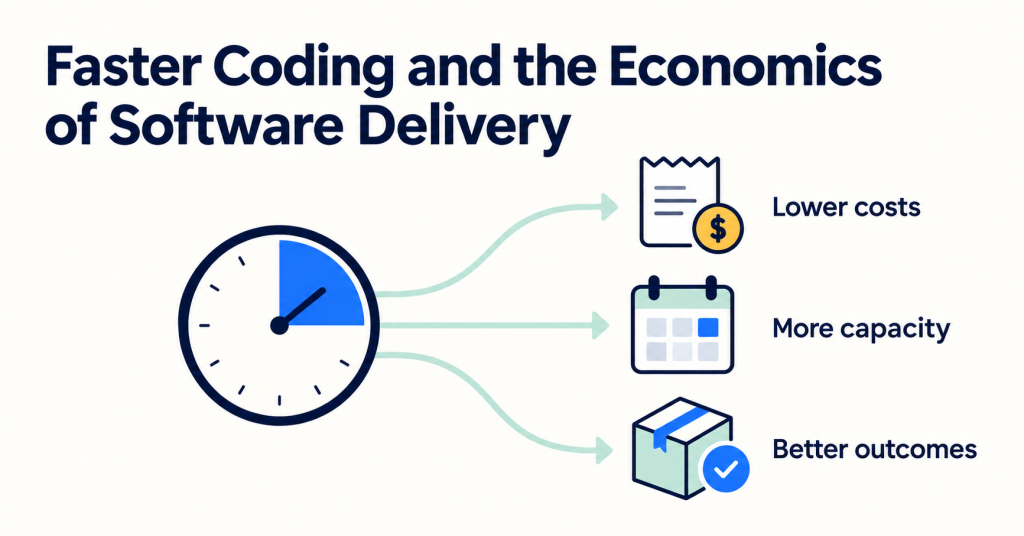
Software delivery economics connects the cost of building, releasing and operating a product to what it achieves. For engineering, product and finance leaders, the task is to follow the saved time through delivery and establish what the business got back.
Name the benefit before you count it
Record the result in the right category, especially if the coding tool was bought with an expectation of lower costs.
| Benefit | What it means | Evidence to look for |
| Expenditure reduced | The business spends less within the agreed cost boundary. | Lower contractor invoices, infrastructure charges or other measured costs, after including the new tool’s costs. |
| Capacity freed | The team has time for other work. | Comparable tasks take less effort, and the team records how it uses the saved time. |
| Product outcomes improved | The change improves a result tied to the product goal. | More customers completing the intended task, fewer support interventions, or another result tied to that goal. |
One change can produce more than one benefit. Keep the evidence separate. Saving an hour in a salaried team does not automatically remove an hour’s pay from the budget. If that time helps avoid a future contractor engagement, record the cost avoided against the agreed plan. Count the same saved hours only once in a combined benefit total.
Follow the saved hours
Consider a hypothetical retailer improving its returns workflow. A comparable change takes 28 hours to implement instead of 40. The team has saved 12 hours on coding.
If review, testing and correction take eight additional hours, four hours remain. If the team uses them to fix a recurring returns defect, it has put the freed capacity to work. Cash expenditure may stay the same.
Then check the returns workflow itself. Measure whether customers complete returns with fewer calls to support and how many intended users adopt the change.
Trace the sequence in the investment review: the effort saved, the capacity available, how the team used it, and the result customers saw. Forecasts can justify an experiment. Keep forecast benefits separate from results already measured.
Count more than the subscription
The subscription price is easy to find. Add the time spent on setup, training, checking suggestions, correcting mistakes and supporting the resulting software.
Start with one product or service and map the costs below. This is a planning aid.
| Stage | Costs to consider |
| Decide | Research, requirements and architecture decisions. |
| Build | Engineering effort, tool subscriptions, setup, training and development compute. |
| Verify and release | Review, testing, security checks, integration, correction and deployment. |
| Run and support | Infrastructure, maintenance, incidents and customer or internal support. |
| Change or retire | Migration, compatibility work and removing old dependencies. |
Agree the cost boundary with finance, and allocate shared costs the same way before and after the change. Leave enough time to observe adoption and the effects on operations.
A feature that takes less time to build can still add permissions, dependencies and support work. Put those ongoing obligations into the decision to build it.
Check whether the work moved
Follow the change beyond implementation. In Dropbox’s account of AI adoption, its engineering leaders describe how higher code output can put pressure on reviews and development infrastructure.[1] That account describes Dropbox’s experience. Your team needs its own comparison.
Sample recent changes and record time spent implementing, waiting for review, reviewing, correcting and releasing. Include the difficult changes and failed attempts.
Keep active effort separate from waiting time. A dependable test environment can bring a release forward even if coding takes the same number of hours. A coding tool can reduce implementation effort while the release date stays put. Those results call for different investments.
Read delivery numbers alongside product use
The SPACE research framework treats developer productivity as a set of dimensions, so a single activity measure cannot describe it.[2] Review delivery, quality, effort and product use together.
Use DORA’s definitions when reporting delivery throughput and instability. Change lead time, for example, runs from code commit to deployment in production.[3]
Also track review and rework effort, adoption by the intended audience, and the outcome the change was meant to improve. Ask the team what sits behind the numbers. More time in review can reflect harder changes or necessary mentoring.
The FinOps Foundation distinguishes resource efficiency measures from business unit measures.[4] Choose a cost unit that connects to the product. For the retailer, consider cost per completed return, including the relevant technology costs and the manual handling of exceptions. Keep completion quality and customer experience beside the cost figure.
Report total expenditure too. Cost per completed return can fall while the total bill rises as more customers use the service. Leaders need both figures to judge the investment.
Give the next investment a testable purpose
Start with one service and a defined class of work. Agree the product goal, establish a baseline and record what the intervention costs. Keep quality expectations consistent. Note changes in staffing, demand or architecture that could affect the comparison.
At the review, establish whether spending fell, where the freed hours went, and what improved for users. Use the evidence to decide whether to expand the tool, address a delivery constraint, or narrow the experiment.
Bring your product goal and delivery constraint to Nineleaps. Explore our product engineering capabilities to discuss where to put the next engineering investment.
Related reading: AI-Augmented Engineering: Beyond the Hype
References
[1] Dropbox CTO Ali Dasdan on moving from AI adoption to transformation
[2] The SPACE of Developer Productivity
