At a Glance
This article explains how Agentic AI moves beyond one-shot responses by planning tasks, using tools, reviewing outputs, collaborating across agents, and balancing autonomy with reliability, control, and human oversight effectively.
If you’ve ever asked an AI a question and got a decent answer, you’ve experienced AI as a tool.
You ask. It answers. Done.
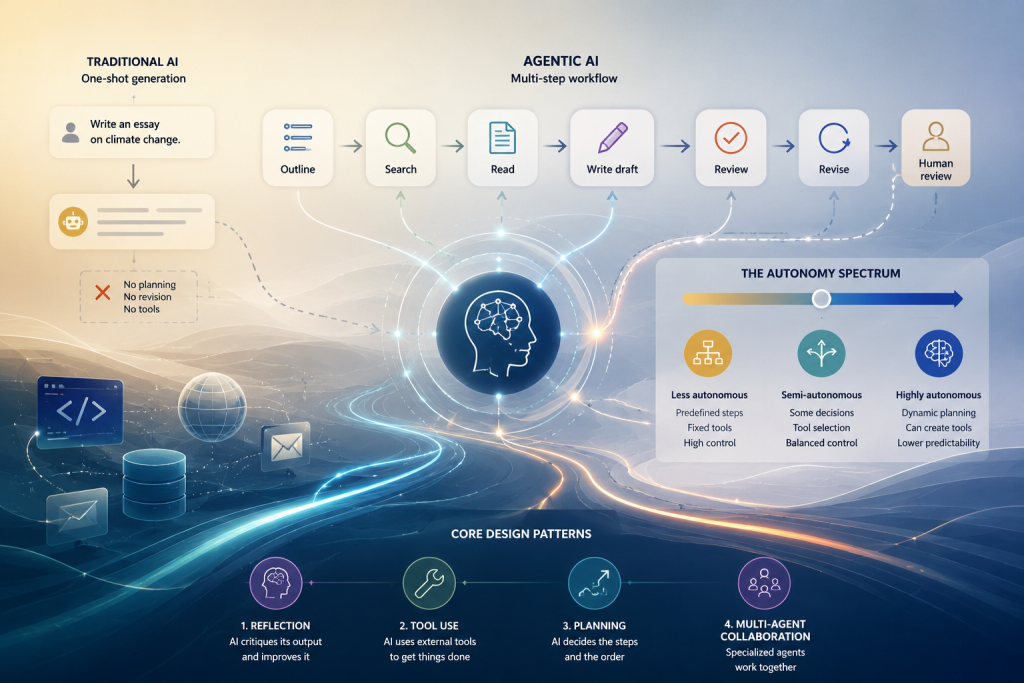
But what if AI could actually work — not just respond, but plan, take steps, check its own output, and complete a task on your behalf, the way a capable human assistant would?
That’s what Agentic AI is. And it’s one of the most important shifts happening in AI right now.
There’s been a lot of hype around the term — marketers have stuck “agentic” onto almost everything in sight. So in this article, let’s cut through all of that and understand what it actually means, with real examples.
The “NO BACKSPACE” problem
Here’s a simple way to understand why regular AI has limits.
Imagine you hired a writer and gave them one rule: write from the first word to the last word, in one go, without ever pressing backspace.
No outlining. No research. No re-reading. No revision. Just start typing and don’t stop.
How good would that essay be?
Not very. Because that’s not how good writing works. Good writing is messy and iterative — you think, outline, draft, read back, cringe a little, revise, research more, and revise again.
Here’s the uncomfortable truth: that’s exactly how most people use AI today. You write a prompt, the model generates a response in one pass, and that’s your output.
This is called direct generation, and while modern AI does surprisingly well given the constraint — it fundamentally limits what’s possible.
What an agentic workflow looks like instead
With an agentic workflow, the AI works through a series of steps — more like how a thoughtful human would actually tackle a complex task.
Take the same essay example. Instead of one-shot generation, an agentic workflow might look like this:
- Write an essay outline on the topic
- Decide what to search for on the web
- Download and read relevant web pages
- Write a first draft using the research
- Read the draft and identify what needs revision
- Revise the draft
- Optionally, flag specific facts for a human to review
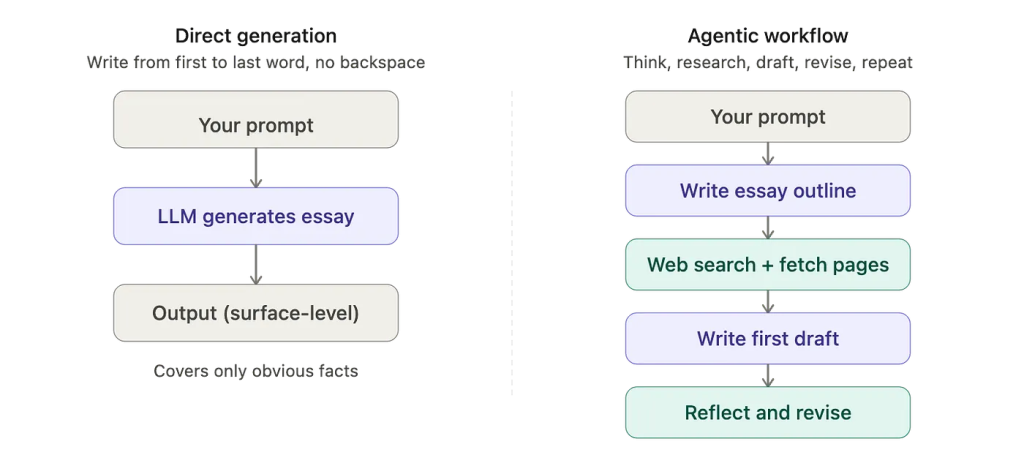
Yes, this process takes longer. But it delivers a fundamentally better result — because the AI can think, gather real information, and improve its own output rather than betting everything on a single pass.
This is the core idea behind Agentic AI: an LLM-based app that executes multiple steps to complete a task, rather than generating an answer in one go.
The Autonomy Spectrum: Not all agents are the same
Here’s something important that often gets lost in the hype: “agentic” is not a binary. Systems can be agentic to different degrees, and the right level of autonomy depends entirely on the task.
Press enter or click to view image in full size
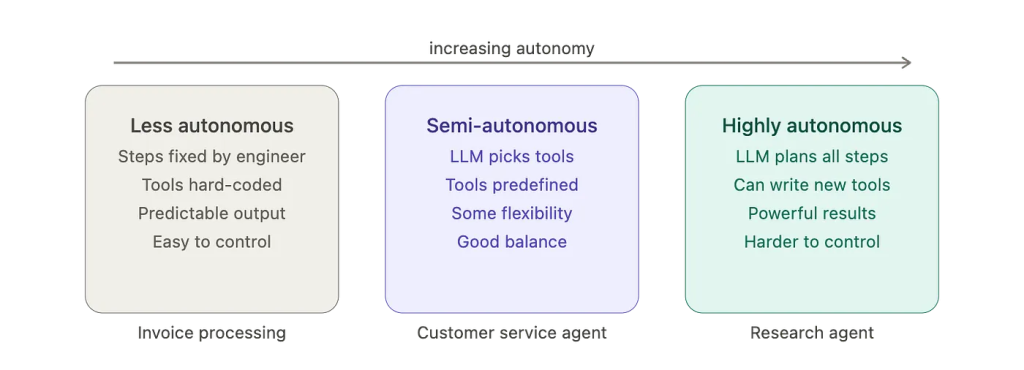
Think of it as a spectrum:
Less autonomous agents have all their steps pre-defined by the engineer. The sequence is fixed, the tools are hard-coded, and the LLM’s job is essentially to fill in the right text at each step. These are predictable, reliable, and easier to build and control. A good example is invoice processing — the steps are always the same: extract the biller name, the amount, the due date, save to database.
Semi-autonomous agents can make some decisions on their own — like choosing which tool to call or how many web pages to fetch — but the available tools are still predefined. A customer service agent that can query your orders database or check return policies is a good example here.
Highly autonomous agents let the AI decide the entire sequence of steps. Some can even write new tools and execute them. These can deliver powerful results but are harder to control and less predictable — very much an active area of research today.
The key insight: both ends of this spectrum are genuinely valuable.
There are thousands of profitable, real-world applications at the less autonomous end. You don’t need a fully autonomous agent to build something incredibly useful. Starting simple, with predictable steps, is often the smarter move.
What makes a task easy or hard for agentic AI
Not every task is equally suited to agentic workflows. Here’s a practical way to think about it:
Easier tasks tend to have:
- A clear, known step-by-step process (like invoice processing or order status checks)
- Text-only inputs (AI language models were built on text — that’s their home turf)
- Steps that can be mapped out in advance
Harder tasks tend to involve:
- Steps that aren’t known until you’re mid-task (a customer asks something unpredictable that requires multiple different database lookups)
- Rich multi-modal inputs like audio, images, or video
- Computer use — agents navigating a web browser, clicking buttons, filling out forms. This is an exciting frontier but still unreliable in production. Slow-loading pages, complex UI interactions, and unpredictable page layouts frequently trip agents up. Watch this space — it’s improving fast.
Design patterns that underpin almost every agentic system
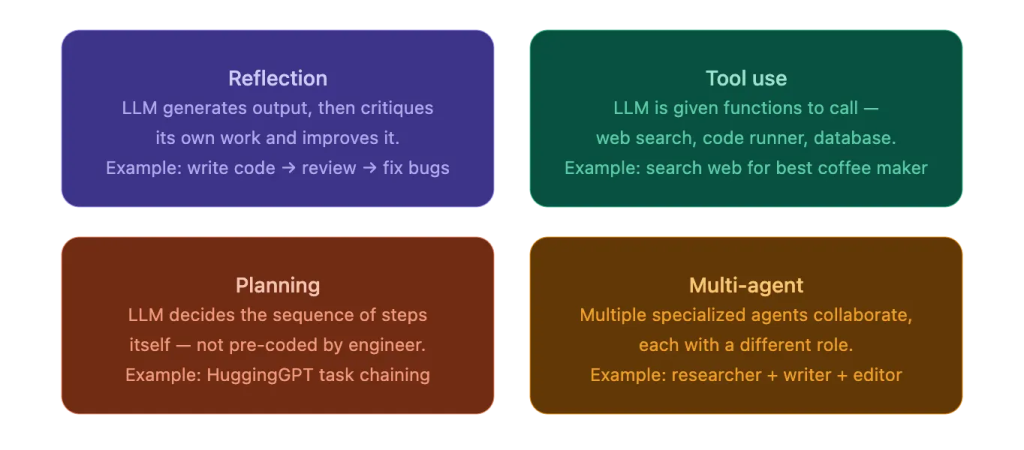
Once you understand these four patterns, you’ll start seeing them everywhere. They’re the building blocks of how agentic workflows are structured.
Press enter or click to view image in full size
1. Reflection
The AI generates an output, then critiques its own work, then improves it. For example: ask an LLM to write code, then feed that code back to the model with the prompt “check this carefully for correctness and efficiency.” The same model often catches its own bugs. You can extend this by having a separate “critic agent” — an LLM specifically prompted to find problems — and having the two go back and forth.
2. Tool use
The AI is given access to external functions it can call: web search, code execution, database queries, email APIs, calendar access. This is what lets an agent get real-world information and take real-world actions, rather than just generating text from its training data. Today’s LLMs can be given tools for everything from math and data analysis to fetching web pages, querying databases, and sending emails.
3. Planning
Instead of the engineer hard-coding a sequence of steps, the AI decides for itself what steps are needed to complete the task, and in what order. This is more powerful and flexible — but also harder to control and somewhat unpredictable. Agents that plan are still somewhat experimental, though they can produce genuinely impressive results.
4. Multi-agent collaboration
Instead of one AI doing everything, multiple specialized agents collaborate, each with a different role. Think: a researcher agent that browses the web, a writer agent that drafts content, and an editor agent that polishes it — all handing off work to each other. Research has shown multi-agent systems can produce better outcomes for complex tasks, though they’re more complex to build and control.
How to think about building agentic workflows: task decomposition
One of the most important practical skills in building agentic AI is task decomposition — taking something complex that a human does and breaking it into discrete steps that an AI can actually execute.
The test for each step is simple: can this be done by an LLM, a short piece of code, or a function call?
If yes, that step is buildable. If no, break it down further.
For example, “respond to customer emails” is too broad. But broken down:
- Extract the key information from the email (LLM can do this)
- Query the orders database for the relevant record (function call)
- Draft a response email (LLM can do this)
- Put it in a queue for human review before sending (tool call)
Each step is now something a machine can do well.
The process is always iterative. You build an initial workflow, test it, find where it falls short, and decompose the problematic steps further. That’s normal — not a sign something went wrong.
Key takeaways
- Agentic AI moves beyond one-shot prompting to multi-step iterative workflows — more like how humans actually work
- “Agentic” is a spectrum, not a binary — systems can be more or less autonomous
- Both ends of the autonomy spectrum are valuable; simpler, more predictable agents are often the right starting point
- Four core patterns structure most agentic systems: Reflection, Tool Use, Planning, and Multi-Agent collaboration
- Task decomposition is the foundational practical skill: break work into steps an AI can actually execute
What’s coming in this series
- Part 1 ← You’re here: What is Agentic AI? Core concepts, design patterns, and the autonomy spectrum
- Part 2: The Reflection Pattern — how AI reviews and improves its own work
- Part 3: Tool Use — giving AI the ability to search, code, and act in the real world
- Part 4: Evals and Practical Tips — the disciplined process that separates good builders from great ones
- Part 5: Highly Autonomous Agents — planning, multi-agent systems, and where this is all headed
This article was originally published on Medium.