At a Glance
This guide explains how to assess data readiness for AI across architecture, governance, data quality, pipeline freshness and operational readiness. It helps teams identify production risks, score gaps, prioritize remediation and determine whether a specific AI use case can scale reliably beyond a controlled pilot.
Data readiness for AI determines whether the information supporting a specific use case can operate reliably in production. It examines four areas: architecture, governance and data quality, pipeline freshness, and operational readiness.
The purpose is not to label an entire organization “AI-ready” or “not AI-ready.” It is to establish whether a specific use case can access accurate, traceable and sufficiently current data at the scale the business requires.
A pilot can succeed despite gaps in these areas. A production system usually cannot.
The business problem
AI initiatives often begin with a promising use case rather than a formal assessment of the data required to support it.
A team identifies an opportunity, gathers the data that is easiest to access and starts building. That approach can work for a proof of concept because the team can manually clean the dataset, resolve inconsistencies and operate within a controlled environment.
The problem appears when the pilot begins moving toward production.
At that stage, the system must work against live data from multiple sources. It must handle changing schema, missing records, duplicated information, access restrictions and operating conditions that were not present in the original demonstration.
Questions that should have been answered before development suddenly become urgent:
- Which system is the source of truth?
- Who owns the data?
- How frequently is it updated?
- Can an output be traced back to its source?
- Can the pipelines handle production volume?
- What happens when a source or transformation fails?
- Is the data permitted to be used by this AI system?
By the time these gaps surface, the pilot may already have executive visibility, committed deadlines and expectations that the production version is close. The infrastructure work still has to happen, but now it happens under more pressure.
A formal readiness assessment identifies these constraints while they are still relatively inexpensive to address.
Why data readiness is not a single score
AI readiness is not determined by one technology, one platform or one model.
It is a profile across several independent dimensions. Weakness in any critical area can prevent a use case from scaling, even when the rest of the environment appears mature.
An organization may have strong governance but rely on batch pipelines that do not meet the needs of an operational use case. Another may have modern cloud infrastructure but no reliable way to establish where a data point originated. A third may have high-quality data but no monitoring process to detect when a pipeline begins producing incomplete results.
Readiness therefore needs to be assessed against the needs of the specific use case.
A customer-support assistant using approved knowledge documents will have different requirements from a fraud-detection system evaluating live transactions. A demand-forecasting model may operate effectively with scheduled updates, while an autonomous agent acting on a changing customer account may require near-real-time context.
The question is not whether the organization has real-time data everywhere. The question is whether the data environment matches the operational needs of the system being built.
Signs your organization needs a formal assessment
A structured assessment is particularly useful when:
- Different teams identify different systems as the source of truth for the same metric.
- Nobody can state with confidence when a critical dataset was last updated or validated.
- Data preparation depends on manual intervention from individual engineers.
- Quality issues are discovered through incorrect AI outputs rather than upstream controls.
- Lineage is documented at a platform level but not for the specific fields used by the AI system.
- The pilot worked on a curated sample but has not been tested against full production volume.
- Security, privacy or compliance reviews have been deferred until after the pilot.
- A previous AI initiative stalled without a clear explanation of which data or infrastructure dependency caused the problem.
- Business and technology teams disagree about whether the existing environment can support the intended use case.
When several of these conditions are present, an informal sense of readiness is not enough. The organization needs a documented assessment tied to the proposed AI workload.
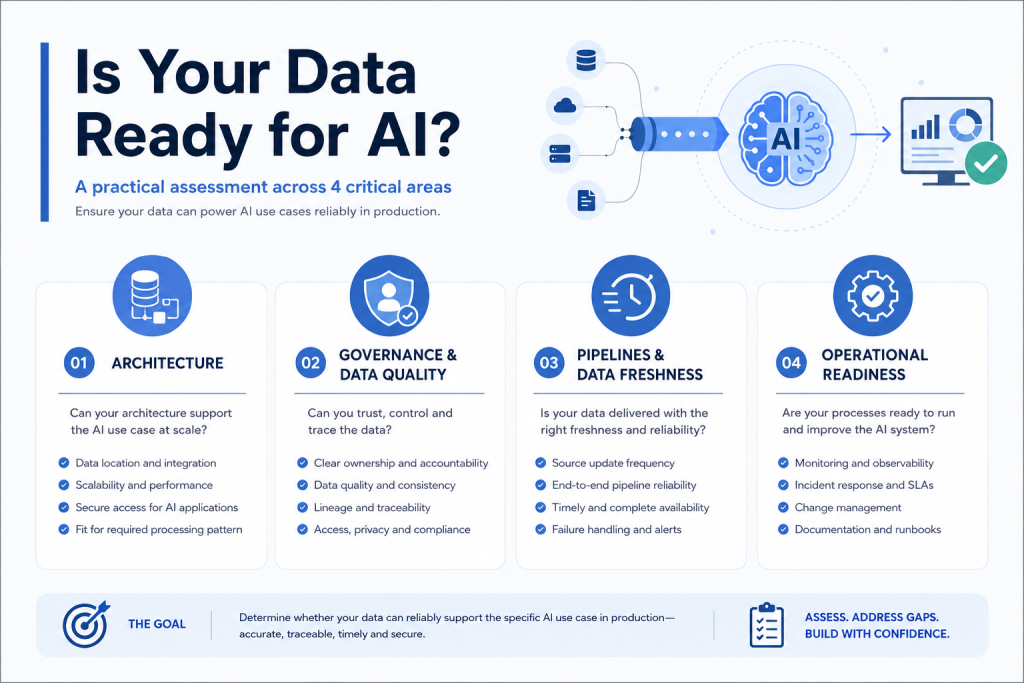
The four areas a data readiness assessment for AI should cover
1. Architecture
The first question is whether the existing data architecture can support the volume, access patterns and dependencies of the AI use case.
The assessment should determine:
- Where the required data currently resides
- Whether it is spread across disconnected systems
- How those systems are integrated
- Whether the architecture can support the expected number of users, requests or decisions
- Whether legacy components create scalability or latency constraints
- Whether data can be accessed securely by the AI application
- Whether the existing platform can support the required processing pattern
A modern cloud platform does not automatically mean the architecture is ready. The relevant data may still be fragmented across operational systems, warehouses, files and third-party platforms.
The assessment should identify the integrations and architectural changes required before production, not after the pilot is approved to scale.
2. Governance and data quality
The next question is whether the organization can trust and control the data being used.
For every critical source, the assessment should establish:
- Who owns the data
- Who is responsible for its quality
- Which definitions govern important business terms
- Whether lineage can be traced from source to AI output
- Whether access permissions are appropriate
- Whether sensitive information is identified and protected
- Whether accuracy, completeness, consistency and timeliness are measured
- Whether quality checks run automatically
Governance should not be treated as documentation that sits separately from the system. It needs to operate inside the data pipelines and access processes supporting the AI application.
A dataset is not production-ready simply because it is available. It must also be understood, authorized and reliable enough for the decision the system is expected to make.
3. Pipelines and data freshness
The assessment should then determine whether the data is delivered at the frequency the use case requires.
This does not mean every AI workload needs streaming infrastructure.
The correct refresh frequency depends on the business decision being supported. A monthly planning model may work with batch data. A recommendation system responding to current customer behavior may need updates within minutes. An agent acting on live operational conditions may require continuously refreshed context.
The assessment should establish:
- How frequently each source currently updates
- Whether that frequency matches the business need
- Where delays occur
- Whether transformations and validation introduce additional latency
- Whether pipeline failures are automatically detected
- Whether replay, recovery and back-fill processes exist
- Whether pipeline performance has been tested at production volume
The goal is to avoid discovering after development that the system is making current decisions using outdated information.
4. Production and operational readiness
The final area is whether the organization can operate the system after deployment.
This includes more than deploying the model.
The assessment should determine:
- Whether the full workflow has been tested at production scale
- Whether monitoring covers both the AI system and its data dependencies
- Who responds when a source or pipeline fails
- Whether data-quality degradation triggers an alert
- Whether outputs can be audited and reproduced
- Whether security and compliance requirements have been reviewed
- Whether the operating cost is understood
- Whether the organization has a rollback or fallback process
- Whether business owners understand the limits of the system
A production AI system needs an operating model, not just an endpoint.
Without ownership, monitoring and response processes, data failures can move silently through the system until they appear as incorrect recommendations, decisions or customer interactions.
How to score the assessment
A simple red, amber and green model is often sufficient.
Green: The requirement is documented, tested and supported by evidence.
Amber: The capability exists partially, depends on manual processes or has not been tested at the required scale.
Red: The capability is absent, unclear or based primarily on assumptions.
Each rating should be supported by evidence rather than team confidence.
For example:
- “We believe the data is accurate” is not evidence.
- A documented quality threshold and recent validation result are evidence.
- “The platform should scale” is not evidence.
- A production-volume performance test is evidence.
- “The business owns the data” is not evidence.
- A named owner with defined responsibilities is evidence.
A project should not move into production while a critical dependency remains red. Amber items should have a clear remediation plan, owner and deadline.
Common assessment mistakes
Assessing the organization instead of the use case
A company may have a mature data platform overall while a specific use case depends on a poorly governed source.
The assessment must follow the actual data required by the system, field by field and source by source.
Treating the exercise as an approval form
Teams eager to begin development may rate readiness generously because a negative finding could slow the project.
The assessment should be treated as a diagnostic exercise, not an administrative step. Involving an independent architecture, governance or engineering reviewer can improve the quality of the result.
Equating modern technology with readiness
Migrating to the cloud does not automatically create accurate data, consistent definitions, documented lineage or effective ownership.
Technology can enable readiness, but it does not replace the operating discipline required to maintain it.
Assuming every workload requires real-time data
Real-time architecture adds cost and complexity. It should be used where the business requirement justifies it.
The assessment should identify the appropriate freshness requirement rather than treating streaming as a default sign of maturity.
Assessing once and never revisiting the result
Data environments change. New sources are added, schema shift, ownership moves and business rules evolve.
Readiness should be reassessed before major releases and whenever a critical source, workflow or regulatory requirement changes.
A practical data readiness for AI checklist
Before moving an AI initiative toward production, confirm that:
- Every critical data source has a named business and technical owner.
- The authoritative source for each important metric or attribute is documented.
- Lineage is available for the specific data feeding the use case.
- Data-quality criteria have been defined and measured.
- Sensitive data has been identified and appropriate controls applied.
- Refresh frequency has been matched to the operational need.
- Pipelines have been tested at production volume.
- Pipeline failures and data-quality degradation generate alerts.
- Monitoring responsibility has been assigned.
- Security, compliance and audit requirements have been reviewed.
- The operating cost has been estimated.
- Recovery, fallback and rollback processes have been defined.
- The business sponsor understands where human review remains necessary.
The checklist should produce a prioritized remediation plan, not just a score.
How Nineleaps approaches data readiness
Nineleaps uses its AI+ methodology to assess where an organization currently sits on the path from isolated pilots to AI-native operations.
The maturity model evaluates four stages:
- Pilot: Standalone experiments operating with limited scope and siloed data
- AI-Enabled: Connected systems supporting departmental AI use cases
- AI+: Unified platforms and integrated intelligence operating across functions
- AI-Native: Real-time, adaptive and increasingly autonomous systems embedded across the business
The initial Assess and Discover phase maps the current data estate, identifies high-value use cases and benchmarks the organization against the maturity model. The output includes an AI-readiness report, a prioritized use-case matrix and an ROI and total-cost-of-ownership model. Nineleaps states that this initial discovery and assessment phase typically takes two to four weeks, depending on the scope and complexity of the environment. (Nineleaps)
For data-readiness engagements, this means connecting the assessment directly to the proposed use case. The work examines whether the relevant architecture, governance controls, pipelines and operational processes can support the required scale before substantial implementation investment is made.
Where governance gaps are central, Nineleaps also applies an architecture and maturity audit to identify structural issues, establish initial ownership and policy frameworks, and create a prioritized modernization roadmap. (Nineleaps)
The research behind this
Nineleaps commissioned a Forrester Consulting study of 205 US IT and business leaders to examine why data engineering is foundational to enterprise AI readiness and what organizations should prioritize before attempting to scale AI initiatives. (Nineleaps)
Read Data Engineering Fundamentals for a Scalable AI Enterprise for the broader research context.
Organizations that identify significant architecture, governance or pipeline gaps can also explore Nineleaps’ Data Engineering services and Data Strategy and Governance capabilities.
Frequently asked questions
How long does a data-readiness assessment take?
Nineleaps’ initial AI+ Discovery and Assessment phase typically takes two to four weeks. The exact duration depends on the number of data sources, complexity of the proposed use case, regulatory requirements, availability of documentation and the amount of technical validation required. (Nineleaps)
Who should be involved in the assessment?
The assessment should involve the business sponsor, data owners, data engineering or platform teams, enterprise architecture, security and compliance representatives, and the team responsible for developing or operating the AI system.
Technical teams can explain how the data is stored and processed. Business teams must explain how current, accurate and complete the information needs to be for the intended decision.
Is a readiness assessment necessary for every AI project?
A lightweight assessment is useful even for a small pilot. The depth of the exercise should reflect the intended risk and scale of the use case.
An internal productivity experiment may require a short review. A system affecting customers, financial transactions, regulated decisions or autonomous actions requires substantially more evidence before production.
What is the biggest data-readiness gap enterprises underestimate?
There is no single gap that applies to every organization. One commonly underestimated issue is the mismatch between how frequently data is updated and how current the AI use case requires it to be.
Governance and lineage are also frequently assumed to be stronger than they are because teams evaluate them at a platform level rather than tracing the exact data used by the proposed system.
Does an organization need a modern data platform before starting AI?
Not always. Some use cases can begin with existing infrastructure if the required data is sufficiently accurate, controlled and accessible.
The assessment should identify what can be achieved using the current environment and what needs to be modernized before the use case can scale safely.